Meet Maslow’s hierarchy of needs:
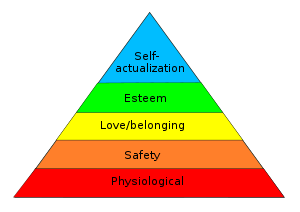
Image credit: Wikipedia user FireflySixtySeven, MaslowsHierarchyOfNeeds.svg, CC BY-SA 4.0.
It’s a psychological theory developed by Abraham Maslow in 1943. The 5 levels of the pyramid are 5 basic categories of human needs. The original idea was that you need to “climb the pyramid” all the way from the bottom in order to satisfy the needs at the top. For example, you will not even pay attention to your safety until your basic bodily needs are met. (You’ll probably take great risks to fulfill them.)
So, what are your needs?
Physiological (bodily) needs include:
- Eating
- Drinking
- Sleeping
- Shelter
- Sex
Safety-related needs include:
- Having senses of emotional, physical, and financial safety
- Health
- Mental well-being
Belonging includes a need to have good social relationships with:
- Friends
- Family
- Romantic partners
Self-esteem is the feeling that you are:
- Valued
- Valuable
- Respected
- Accepted
Finally, self-actualization is becoming whom you want to be by taking the actions you want to take.
I want to dissect each of these needs and talk about how I did something I thought I could never do: satisfy them.
Bodily Needs
I feel very fortunate that my bodily needs are generally met. But there are actually a number of times when they’re not fully met. We commonly fail to meet our bodily needs when we do things like:
- Don’t go to sleep when our body expects to
- Don’t sleep for a long enough time
- Don’t drink water despite being thirsty, because we’re working on something
- Put off eating when we’re hungry, for the same reason
- Go outside during the winter
I actually do all of those things all the time, and the difference between how I feel when I’m guilty of all of them and how I feel when I’ve slept, ate, and drank well is astounding. Sleep in particular drastically affects my day.
Modern psychologists tend to think we can meet some of Maslow’s needs out of order, and I agree, but I think Maslow was right in that we’re not going to do very well in the higher levels of the pyramid if we don’t have our bodily needs down-pat. We tend to struggle to have a good conversation or act as we’d like when we’re tired and dehydrated, so physiological needs are an important thing to keep in mind. Listen to your body.
Safety
Safety, at first glance, seems like a silly thing to worry about for a middle-class person in a first-world country. Even if that describes you, there are still a number of things that can make someone like you feel unsafe. Remember that safety includes good physical and mental health and a sense of emotional and financial security.
Financial security is relevant to nearly everyone. Let’s say you have to find a job right out of school or after being laid off. You may well, after so many rejections and “silent treatments,” feel an immense threat to your financial safety and grave uncertainty about your future. You may feel a similar uncertainty when you’re switching gears into a new career path. It seems almost inevitable that college students will experience financial stress.
Not feeling safe financially may keep you from going to the doctor and the dentist. It’ll keep you from eating enough and eating well. In a capitalist society, many good things, including good health, follow from financial security. But it alone will not make you happy. If you achieve it, it’s just easier to check out the other pieces of the pyramid.
Mental health in particular is crucial. I’ve experienced severe depression, so I consider myself qualified to talk about the topic. During the past couple of years, I was able to move past it, but for a long time it was an astounding barrier to living life. It kept me from moving forward, and it kept me from climbing up. Facing it alone would have been like climbing a four-story brick wall with no equipment, and I could never have healed without other people.
Get help if you need it, whatever it is that makes you feel unsafe.
What may seem the least noteworthy of the 5 needs is actually one of the most complicated. But where possible, it is highly beneficial to work toward good physical and mental health. It’s not selfish if it helps you be a better person to everyone else.
Belonging
This one hits me personally, too. For most of my life, I did not feel that I belonged. I was never (anywhere near) the popular kid. No one expressed romantic interest in me, and I didn’t express romantic interest in anyone (I didn’t think I’d have a shot in the dark). I isolated myself, both in response to this and in order to further myself academically and professionally, and I firmly believe that contributed to the mental health issue I mentioned above. I don’t know if it was social isolation that lead to poor mental health, but it was definitely forming better social ties that healed me. I think they (along with therapy) were the most effective antidepressant I could have taken; and notably I healed without ever taking an antidepressant. (I nonetheless understand and respect that some people need them.)
I began to feel better when I attended more clubs at school. I began to feel better as the number of people I could call a friend grew (and worse the two times it shrank). I began to feel better as I deepened those friendships through face-to-face interactions. I’ve met some of the most amazing people I know in the past two years.
I think the best tool for climbing this piece of the pyramid is simply: invite people places. Be the initiator. Ask them if they want to get lunch. Ask them if they want to study together. Ask them if they want to go to an art festival. Ask them if they want to play music together. Sometimes they’ll say no. Many times, they will say yes.
Sometimes they will ghost you. Someone else will say yes.
And before you know it, they’ll be inviting you places, too. Do this over and over, and your relationships will probably get stronger. It got me over even the level of social detachment that I used to feel. I have little advice beyond reaching out, because after that I just do whatever comes naturally. But since this is the “social” section, I feel the need to work in a word on communication. Expressing what’s on your mind is mutually beneficial in any relationship. We tend to think people know how we feel, but there’s no guarantee of that unless we tell them. Say what’s on your mind.
(And listen to what’s on theirs.)
Self-esteem
It’s hard to think of self-esteem as one of your human needs. That’s not because it’s unimportant, but because it’s largely how you think others see you. Poor self-esteem is essentially feeling that you’re not “good enough” for people. It may actually be their fault, not yours, when the people in your life aren’t showing appreciation for you.
One thing you can do to boost your self-esteem is help people–with a math problem, a personal problem, or a hobby you both engage in. It doesn’t matter. The chemistry behind that interaction can be sort of magical. It will make you feel more valuable.
Another aspect of self-esteem, according to Maslow, is self-respect. It can be more tightly tied to skills. Do you feel you’re good at your work; do you feel you’re a good parent; do you feel you’re good at your hobbies? I suggest looking back at your past achievements (especially if they’re written or otherwise recorded) and also asking for feedback from others. For example, I was recently afraid my music was trash, so I sought feedback from some friends, and it turned out they liked it.
I’ll end this section with a word of caution: social media can be a bad self-esteem booster. Yes, you’ll feel good when people like your post, but it can be a temporary feeling. You may start to wonder why certain friends didn’t like it, and the feedback you get won’t feel nearly as relevant as feedback you get face-to-face. It can be hard to figure out what a “like” really means, because it’s literally a picture of a thumb. You may make a game of counting how many reactions you get, and sometimes there aren’t enough to make you happy. Social networks don’t exist to make you feel better; they exist to generate money from advertising, and there is a number of arbitrary reasons why your post may not have been popular and why particular people might not have seen it. It’s decided by a computer somewhere very far away. Research suggests that more active communication–receiving thoughtful comments instead of one-click reactions, for example–leads to a better experience. But seeing a smiley emoji will never beat seeing a smile, and so I suggest seeking self-esteem (and belonging, for that matter) through the real world as much as possible. The brain evolved to understand and thrive on face-to-face interactions.
Self-actualization
Two years ago, I never thought I would get to the top of the pyramid. I could barely act the way I wanted to act. Shyness and nerves would always get in the way.
Sometimes acting the way you want to act means letting go of inhibitions. You won’t do it all at once.
You need to gain courage and will to say and do the right thing. For me, this is a constant, ongoing process of trying things that make me uncomfortable. Eventually I get used to them, and they become much easier to do. Some examples have included talking to the opposite sex, striking up a conversation with someone I see as superior, speaking up when something bothers me, asking out a ridiculously beautiful girl, and trying a daunting project. The best way to get over your fears is by defying them.
Eventually I became most concerned with how to use my free time to make a better impact on the world and how best to further causes I believe in, and that was when I decided I was qualified to write this.
I don’t mean these to be turn-by-turn directions for repairing your pyramid. To think what applies to me must apply to you would be self-centered. Part of what makes it hard to write this sort of thing is that there is no back and forth between us, so I don’t know what obstacles you’re facing or what mountains you want to climb. We’re all unique, and our needs manifest themselves in different ways and in different contexts. So if you like my ideas for satisfying one need or another, steal them(!), but I bet you can also come up with some that are tailored for you. The important thing is that you become a better, healthier you.
[Much credit is due to Abraham Maslow’s original ideas. It is unfortunate that he viewed “neurotics” (people with a mental illness) as subhuman and possessing a malformed hierarchy much like that of children. He said that “the study of crippled, stunted, immature, and unhealthy specimens can yield only a cripple psychology and a cripple philosophy.” Just now discovering this, I find it ironic that his ideas have served as a guide to me as I’ve healed. I also find it ironic that studying mental illness is now a cornerstone of psychology.
Having a mental illness does not make you worth less. To take one condition as an example, Charles Darwin, Winston Churchill, Abraham Lincoln, Isaac Newton, all of these famous people, and 1 in 10 Americans struggle(d) with depression. Darwin also had a boatload of anxiety and panic attacks. Churchill and Lincoln even contemplated suicide. Do you think any less of them now?
Didn’t think so.
Thankfully more modern and permissive interpretations of Maslow’s needs are also summarized by the wonderful Wikipedians who wrote up this page.]


